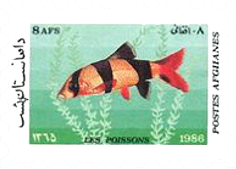
The Clown loach (Chromobotia macracanthus) originally comes from Southeast Asia. It is often offered in aquarium shops, but at over 30 cm it becomes too large for commercially available aquariums.
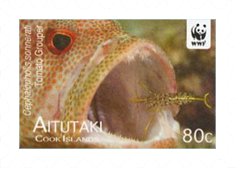
Aitutaki 2010
The Tomato grouper (Cephalopholis sonnerati) is characterized by its orange to red coloration. It feeds on fish and crustaceans, but is itself also a popular food fish.
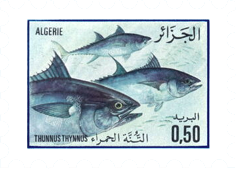
Algeria 1985
The Bluefin tuna (Thunnus thynnus) can grow up to four meters long and weigh up to 600 kg. Due to overfishing, it was on the Red List of endangered species for many years.
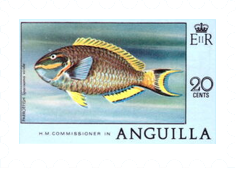
Anguilla 1978
This Parrotfish (Sparisoma viride) predominantly inhabits coral reefs in Florida, the Caribbean, and the Gulf of Mexico. With their beak-like teeth, they graze on the corals.
Bahamas 2012
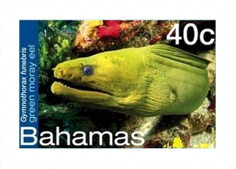
The Green moray (Gymnothorax funebris) is widespread in the western Atlantic. It occurs from North America to southern Brazil. It is considered aggressive and its bite can be dangerous.
Benin 1999
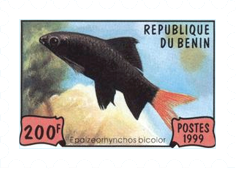
The Red-tailed shark (Epalzeorhynchos bicolor) in my opinion unjustly enjoys the reputation of being an aggressive aquarium fish. When kept properly, it is usually peaceful and a very good algae eater.
Burkina Faso 1997
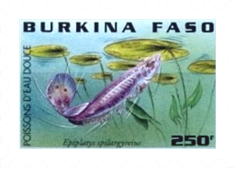
This rare stamp shows a Diagonally striped killifish native to Africa (Epiplatys spilargyreius). This small fish only grows to about 6 cm and in the aquarium usually stays in the upper area.
Burundi 2014
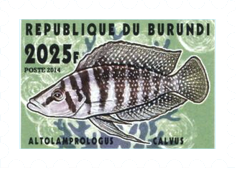
The Pearl cichlid (Altolamprologus calvus) is found exclusively in Lake Tanganyika. It can be kept well in an aquarium with the appropriate water conditions, as it is relatively peaceful.
Cook Islands 2007
With a possible weight of more than 2.5 tons, the Ocean sunfish (Mola mola) is the heaviest known bony fish in the world. It is characterized by its tall, laterally flattened shape.
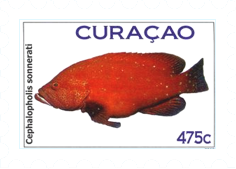
Curacao 2012
As already shown on the stamp from Aitutaki, here is once again a Tomato grouper (Cephalopholis sonnerati). This solitary fish primarily lives at depths between 30–100 meters.
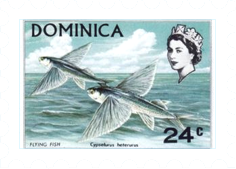
Dominica 1970
The Atlantic flying fish, or simply flying fish (Cheilopogon heterurus), can glide over water for long distances. When escaping predators, it can “fly” over 50 meters.
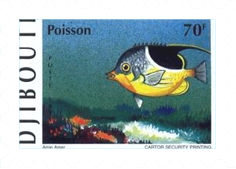
Djibouti 1999
A very rare and hard-to-get stamp in the early years featuring a Saddle-spot butterflyfish (Chaetodon ephippium). These butterflyfish live in coral reefs in the Indo-Pacific.
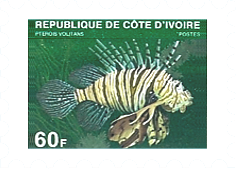
Ivory Coast 1979
Another rare stamp. It features a Lionfish (Pterois volitans). It is a voracious predator and for this reason is controlled and reduced in some coral reefs.
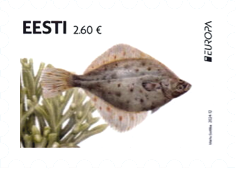
Estonia 2024
The Baltic flounder (Platichthys solemdali) is a flatfish that is endemic to the Baltic Sea. It primarily feeds on mussels and other benthic invertebrates.
France
2015
Stamp issue featuring eyes. One shows the eye of a Whitetip reef shark (Triaenodon obesus). It is a medium-sized shark with an average body length of about 1.50 meters.
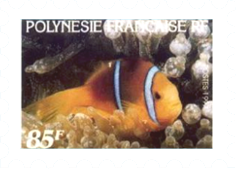
Polynesia
1997
This Polynesian clownfish (Amphiprion maohiensis), found in the coral reefs of French Polynesia, was only classified and described as a distinct species in 2025.
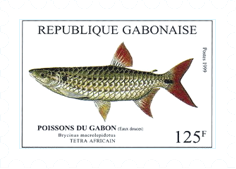
Gabon 1999
In 1999, a set “Native Fish” with four stamps was issued in Gabon. This stamp shows a Largescale robber (Brycinus macrolepidotus), widespread in Africa. It is a freshwater fish.
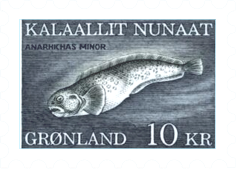
Greenland 1984
The preferred habitat of the Striped wolffish (Anarhichas minor) is the seafloor. Here it searches for mussels, crabs, and sea urchins. With its adapted mouth, it literally cracks them open.
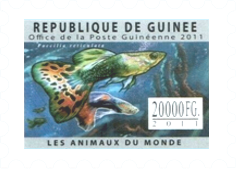
Guinea 2011
The Guppy (Poecilia reticulata) is one of the most popular freshwater ornamental fish. It originally comes from South America and is now widespread worldwide. It is also used for the natural control of mosquitoes.
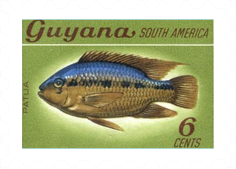
Guyana 1968
The Black Acara (Cichlasoma bimaculatum) is a cichlid from the rivers and lakes of South America. This stamp was issued in the following years with several different overprints.
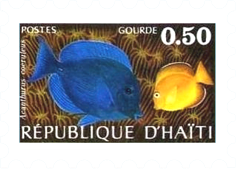
Haiti 1973
The Atlantic blue tang (Acanthurus coeruleus) occurs predominantly in the western Atlantic. Juveniles are brightly colored yellow. Later the color changes to the namesake blue.
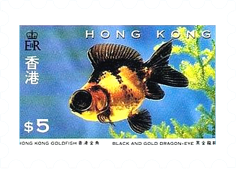
Hongkong 1993
The Goldfish (Carassius auratus) is a particularly popular cold-water fish. It originally comes from China and is considered the oldest domesticated animal. There are numerous bred varieties of it that differ greatly in body shape and color.
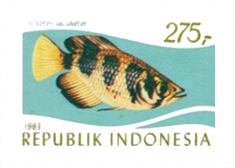
Indonesia 1983
The Banded archerfish (Toxotes jaculatrix) is a fascinating predatory fish from Southeast Asia known for its ability to shoot insects off shoreline plants with a precise jet of water. It lives in brackish mangrove habitats.
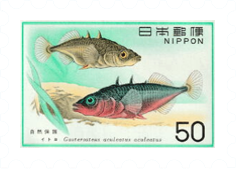
Japan 1976
The Three-spined stickleback (Gasterosteus aculeatus) is a widely distributed and well-known cold-water fish in the Northern Hemisphere. It was also the first fish I tried to keep in an aquarium.
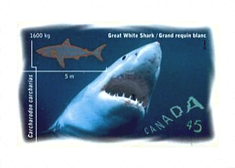
Canada 1997
Especially through the film “Jaws,” one of the most well-known sharks. The Great white shark (Carcharodon carcharias) is the largest predatory fish and by far responsible for the most documented shark attacks on humans.
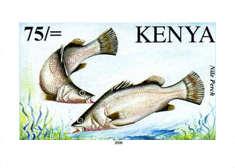
Kenia 2006
The Nile perch (Lates niloticus) is a popular food fish. In the 1960s, Nile perch were introduced into Lake Victoria. They reproduced there in a spectacular way and displaced other species.
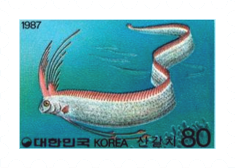
Korea 1987
The Oarfish (Regalecus glesne) can reach a length of up to 8 meters, making it the longest bony fish. Although it has a very wide distribution, it is rarely seen. Most often, dead specimens are found on the beach.
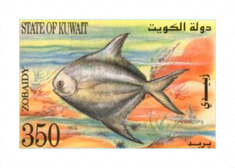
Kuwait 1997
The White Butterfish (Pampus argenteus) lives in the coastal waters of the Middle East, East Africa, and South Asia, feeds on zooplankton, and is a prized food fish due to its delicate flesh.
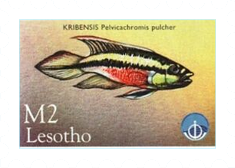
Lesotho 1998
In Lesotho, a 1998 issue of Fish was released with a total of 53 stamps featuring fish. One stamp from it shows the Purple cichlid (Pelviachromis pulcher), which is very popular among aquarists.
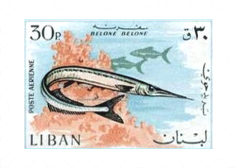
Lebanon 1968
The European garfish (Belone belone) is a very slender marine fish found in the northeastern Atlantic and its adjacent seas. The bones and skeleton of cooked garfish are green.
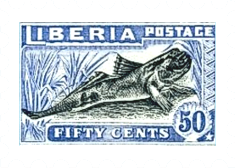
Liberia 1918
From an evolutionary perspective, the African mudskipper (Periophthalmus barbarus) has undergone a special development that allows it to transition from water to land. The mudskipper is capable of breathing air.
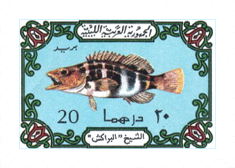
Libya 1973
The Painted comber (Serranus scriba), found in the Mediterranean and eastern Atlantic, resembles the much larger groupers in body shape. However, its average length is only 15–25 cm.
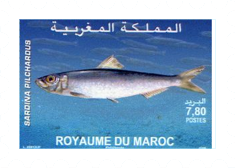
Morocco 2006
Sardines (Sardina pilchardus) are small fish that form huge schools during their migrations. This behavior is meant to protect the individual from its predators. They feed on fish eggs, larvae, and small crustaceans.
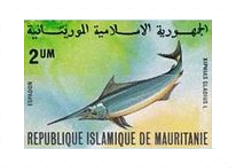
Mauritania 1979
The Swordfish (Xiphias gladius) is a large, predatory fish found worldwide in temperate to tropical seas. It usually grows 2–3 meters long. Its namesake sword-like bill can reach a third of its body length.
Monaco
2021
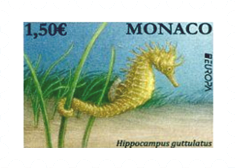
The Long-snouted seahorse (Hippocampus guttulatus) lives in seagrass meadows and kelp forests in the Atlantic and Mediterranean. As with other seahorse species, it is the male that broods the eggs in his brood pouch.
Mongolia 1998
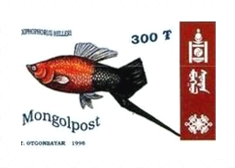
Originally, the Swordtail (Xiphophorus hellerii) comes from Mexico and Central America. Today, it can be found in many other parts of the world, as humans have released it into natural waters there.
Namibia 1992
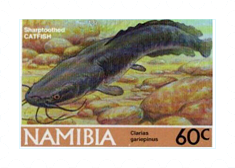
The African catfish (Clarias gariepinus) is widespread in Africa. It lives in standing bodies of water that usually dry up during the dry season. They are able to bury themselves in the mud and survive there for a certain period of time.
Newfoundland 1866
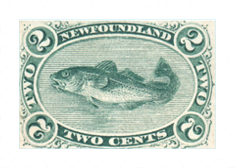
This is the first postage stamp with a fish motif. It was issued in 1866 and shows an Atlantic cod (Gadus morrhua). Then as now, cod is one of the most important and also most commonly caught food fish.
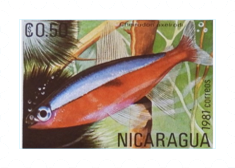
Nicaragua 1981
What would a collection on the topic of fish be without the neon fish. Here the Red Neon (Cheirodon axelrodi). Originally they come from Brazil. Today most neons are bred in the Czech Republic.
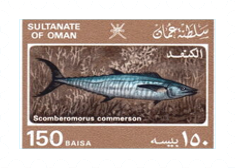
Oman 1985
The Torpedo mackerel (Scomberomorus commerson) is a predatory fish that is primarily native to the Indo-Pacific. The species is commercially fished, is known as a sport fish, and is now increasingly threatened.
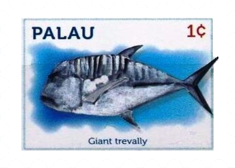
Palau 2009
The giant trevally (Caranx ignobilis) live as predators and hunt almost any fish by rushing at the prey at high speed and thereby stunning it. Escape is almost impossible for the prey fish.
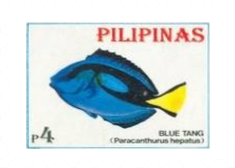
Philippinas 1996
The palette surgeonfish (Paracanthurus hepatus) became especially well known through the character “Dory” in the films “Finding Nemo” and “Finding Dory.” They have a bright blue color and a yellow tail.
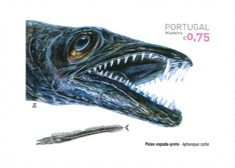
Madeira 2007
The black scabbardfish (Aphanopus carbo) is a slender deep-sea fish that is on average 1.20 meters long. It lives at depths of 100–200 meters in the North Atlantic. It is a popular food fish especially around Madeira.
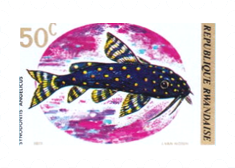
Rwanda 1973
In aquaristics, the Angel squeaker (Synodontis angelicus) has been known for a very long time. It belongs to the family of upside-down catfishes. In an aquarium it grows to about 24 cm in length. In the wild it can become significantly larger.
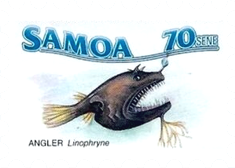
Samoa 1987
Among the deep-sea anglerfish, the devil anglers (Linophryne densiramus) are considered the most bizarre representatives, possess the largest mouths, and have particularly long teeth in relation to their body length.
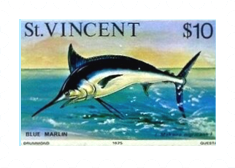
St. Vincent 1975
The Atlantic blue marlin (Makaira nigricans) is a large predatory fish that can grow up to 5 meters long and weigh over 750 kg. Due to its strength and speed, it is one of the most sought-after trophy fish for anglers worldwide.
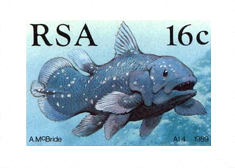
South Africa 1989
The Comoros coelacanth (Latimeria chalumnae) is a rare, primitive fish that is known as a “living fossil” because its morphology has remained almost unchanged for millions of years. It was rediscovered off South Africa in 1938.
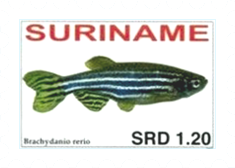
Suriname 2007
The zebrafish (Danio rerio) is a very robust schooling fish from South Asia that grows to 4–6 cm in length. While it has been a popular ornamental fish here for decades, in India it is dried in large quantities and eaten.
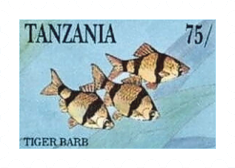
Tanzania 1991
The Sumatran barb (Puntigrus tetrazona) is a small, lively ornamental fish that is popular in aquariums. There are genetically modified versions of them that glow, so-called glowfish, whose keeping is prohibited in the EU.
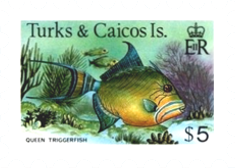
Turks & Caicos 1979
The Queen triggerfish (Balistes vetula) is a colorful inhabitant of tropical Atlantic reefs that can grow up to 60 cm long. It has a green-blue body, a yellow underside, and distinctive blue lines on its face.
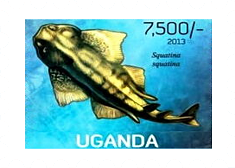
Uganda 2013
The Angelshark (Squatina squatina) is a bottom-dwelling shark threatened with extinction. This species looks very similar to rays, but its gill slits are located on the sides of the head. It lives in the North Atlantic and in the Mediterranean.
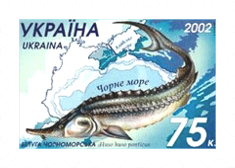
Ukraine 2002
The European beluga or beluga sturgeon (Huso huso) is one of the largest bony fish in the world. The beluga is used for the production of Beluga caviar and is considered highly endangered due to overfishing and loss of habitat.
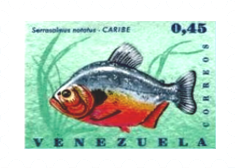
Venezuela 1966
The Red-shoulder spot piranha (Pygocentrus cariba) is one of about 40 species of piranhas. In nature, piranhas mainly eat sick and injured or already dead animals. Humans are usually only attacked accidentally.
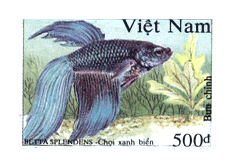
Vietnam 1992
The Siamese fighting fish (Betta splendens) is known for its pronounced aggression toward members of its own species. Males fight each other to the death. Fighting fish have long been bred in many colors and fin shapes.
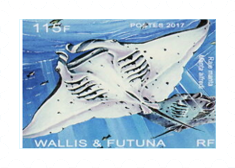
Wallis & Futuna 2017
The Manta ray (Mobula birostris) is the largest ray in the world, known for its impressive wingspan of up to nine meters and its elegant, wing-like movement. On the underside, each animal has a unique pattern of spots.
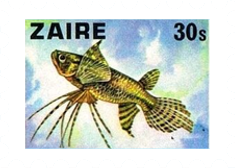
Zaire 1978
The Butterflyfish (Pantodon buchholzi) is a specialized fish from West Africa that grows up to 12 cm in length. It has wing-like pectoral fins with which it can make long jumps to catch insects.